
UPI MDR on Transactions Above ₹2,000: What Businesses and Customers Need to Know
UPI MDR on Transactions Above ₹2,000: What Businesses and Customers Need to Know
India’s Unified Payments Interface (UPI) is set for an important change from 15 October 2026. A new Merchant Discount Rate (MDR) framework will introduce charges on certain Person-to-Merchant (P2M) UPI transactions above ₹2,000.
However, the change does not mean that every UPI transaction above ₹2,000 will automatically attract a customer-facing fee.
The new framework primarily affects the merchant side of eligible transactions, while Person-to-Person (P2P) UPI payments will continue to remain free.
The Ministry of Finance and Press Information Bureau have clarified that approximately 96% of P2M UPI transactions will remain unaffected.
What Is Changing in UPI?
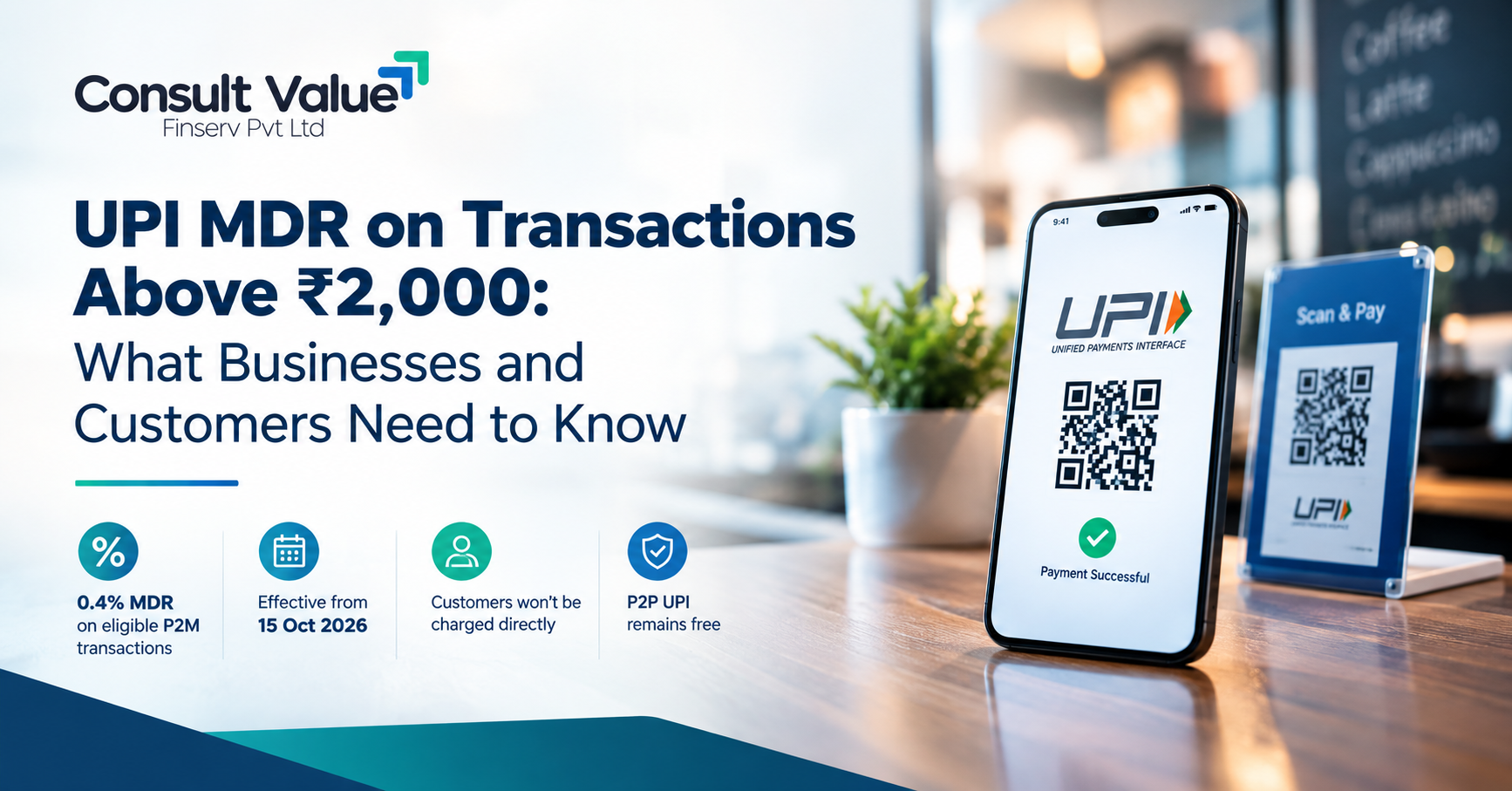
From 15 October 2026, a 0.4% MDR will apply to specified P2M UPI transactions above ₹2,000.
MDR, or Merchant Discount Rate, is a fee associated with accepting digital payments. Under the new UPI framework, the MDR is distributed among participants in the payment ecosystem, including banks, payment service providers and UPI application providers.
For eligible transactions of ₹75,000 and above, the MDR will be capped at ₹300 per transaction.
For example:
- ₹3,000 eligible UPI merchant payment → 0.4% MDR = ₹12
- ₹10,000 eligible transaction → ₹40
- ₹50,000 eligible transaction → ₹200
- ₹75,000 eligible transaction → ₹300
- ₹1,00,000 eligible transaction → capped at ₹300
The actual applicability, however, depends on the merchant and transaction category under the framework.
Will Customers Have to Pay for UPI?
No direct MDR will be charged to customers.
The government has specifically clarified that MDR is a charge within the merchant payment ecosystem and is not a customer-facing UPI transaction fee.
Banks have also been advised to ensure that merchants do not pass MDR charges on to customers, while UPI application providers are prohibited from imposing platform fees or hidden charges related to this framework.
This means that a customer making an eligible ₹5,000 UPI payment should not see an additional ₹20 UPI fee simply because the transaction crosses ₹2,000.
However, businesses will need to understand how the additional payment cost affects their own payment economics and pricing decisions.
What Will Remain Free?
Several important categories remain outside the new MDR framework.
1. Person-to-Person UPI Payments
P2P transactions will continue to remain free, irrespective of the amount transferred.
For example, transferring ₹10,000 to a friend or family member will not attract the new MDR.
2. Merchant Payments Up to ₹2,000
P2M UPI transactions up to ₹2,000 will continue to remain free of MDR.
This protects the majority of everyday low-value merchant payments.
3. Small Merchants
Small merchants covered under the zero-MDR framework will continue to receive protection.
The government has stated that small merchants receiving up to ₹1 lakh per month through UPI QR-code payments under the applicable P2PM category will continue to enjoy zero MDR.
Approximately 96% of Merchant Transactions Will Remain Unaffected
One of the most important points in the new framework is the scope of the change.
According to the Ministry of Finance, MDR will apply to only about 4% of merchant transactions, meaning approximately 96% of P2M transactions will remain unaffected.
This is because transactions below the ₹2,000 threshold and transactions covered by the zero-MDR framework for small merchants remain outside the new charge structure.
Therefore, saying that “UPI will now be charged” is an oversimplification.
The change is specifically targeted at certain merchant transactions rather than UPI as a whole.
Special Rates for Certain Sectors
The framework also provides different MDR treatment for specific categories.
Transactions above ₹2,000 in certain essential and thin-margin sectors, including railways, telecommunications, insurance, fuel and agricultural inputs, will attract a flat MDR of ₹5 per transaction.
Capital-market-related payments, including payments relating to mutual funds, securities, stockbrokers and dealers, will attract an MDR of 0.02%, subject to a ₹300 cap.
This means businesses cannot assume that the standard 0.4% rate applies uniformly to every merchant transaction above ₹2,000.
Why Is UPI MDR Being Introduced?
UPI has grown into one of India's largest digital payment networks, processing billions of transactions every month.
According to NPCI and the Ministry of Finance, the MDR framework is intended to create a more sustainable economic model for the UPI ecosystem.
The revenue generated through MDR will be distributed among payment ecosystem participants and is intended to support areas such as:
- Payment infrastructure
- Cybersecurity
- Fraud prevention
- Innovation
- Customer service
- Expansion of digital payment acceptance
The government has also announced a dedicated fund for promoting UPI adoption among small merchants, with an amount equivalent to 5% of total MDR collections allocated to the fund.
Reuters similarly reported that the new framework is intended to support investment in infrastructure resilience, innovation, cybersecurity and customer service.
What Does This Mean for Businesses?
For businesses accepting UPI payments, the key change is that certain higher-value transactions may now have an associated payment-processing cost.
Businesses should therefore review:
- Their monthly UPI transaction volume
- Average UPI transaction value
- The proportion of transactions above ₹2,000
- Merchant category and applicable MDR rate
- Payment gateway and banking arrangements
- Accounting treatment of payment-related charges
For businesses with significant digital payment volumes, even a relatively small percentage-based cost can become relevant when considered across hundreds or thousands of transactions.
It will therefore be important for finance teams and business owners to monitor the actual MDR deductions once the framework becomes operational.
Is UPI No Longer Free?
The answer depends on what is meant by “free UPI.”
UPI will continue to be free for individuals using P2P transactions, and merchant payments up to ₹2,000 will remain free. Small merchants covered under the zero-MDR framework are also protected.
At the same time, specified higher-value merchant transactions will no longer operate under a zero-MDR structure from 15 October 2026.
So, the more accurate way to describe the change is:
UPI is not becoming a paid service for consumers. Instead, selected merchant transactions are moving to a limited MDR-based model.
Conclusion
The introduction of MDR marks a significant change in the economics of UPI payments, but it is important to separate the facts from headlines.
From 15 October 2026:
- 0.4% MDR will apply to specified P2M transactions above ₹2,000
- MDR will be capped at ₹300 for transactions of ₹75,000 and above
- P2P UPI transactions will remain free
- Merchant payments up to ₹2,000 will remain free
- Eligible small merchants will continue under zero-MDR provisions
- Customers will not be directly charged MDR
- Approximately 96% of P2M transactions are expected to remain unaffected
For businesses, the important step is not simply understanding the headline rate but identifying how the new framework applies to their own transaction profile and payment setup.
Sources: Ministry of Finance / Department of Financial Services, Press Information Bureau, NPCI framework and Reuters reporting. The Department of Financial Services published the official MDR press release and FAQs on 15 September 2026.
Have Questions? We're Here to Help
Get expert advice from Consult Value Finserv Pvt Ltd. Reach out to discuss your requirements.